
Research CatalogueGenAI Skills Scarcity Report 2026: What Enterprises Are Actually Hiring and Cannot Find
Research Report2026-07-0886 pages

GenAI Skills Scarcity Report 2026: What Enterprises Are Actually Hiring and Cannot Find

Talenbrium Research  |  2026-07-08  |  By Talenbrium Research  |  Talenbrium Proprietary Intelligence
AI skills are now the single hardest capability for employers to find, globally

ManpowerGroup's 2026 Talent Shortage Survey — drawing on 39,000 employers across 41 countries — found that for the first time in the survey's history, AI skills have surpassed all others to become the most difficult capabilities to source globally. This is not a technology sector story. AI fluency requirements appear in 2.5% of all US job postings, a 297% increase over the past decade (Stanford HAI 2026 AI Index), and the growth is accelerating across financial services, healthcare, manufacturing, and logistics.

This Talenbrium report delivers a granular breakdown of which specific generative AI capabilities are scarcest, how scarcity varies by sub-skill and geography, where adjacency opportunities exist for reskilling, and what compensation premiums the market is applying to each capability cluster.
72%
Employers globally reporting difficulty filling roles (AI skills primary)
ManpowerGroup 2026 · 39,000 employers, 41 countries
297%
Growth in AI-skill job postings over past decade
Stanford HAI 2026 AI Index
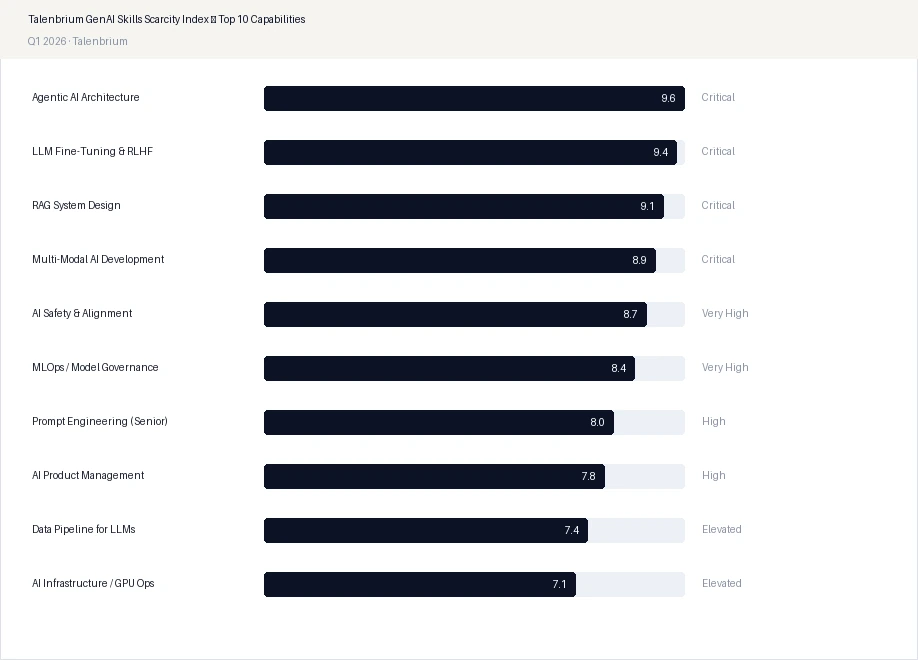
9.6/10
Scarcity index: Generative AI development
Talenbrium Q1 2026
+31%
Compensation premium for verified GenAI proficiency over base role
Talenbrium comp. model Q1 2026
Talenbrium GenAI Skills Scarcity Index — Top 10 Capabilities
The skills gap is structural, not cyclical

The WEF Future of Jobs Report 2025 projects that 39% of workers' core skills will be transformed or become outdated by 2030. For generative AI specifically, the transformation is happening in a two-to-three year window. The capabilities that were considered advanced twelve months ago — basic prompt engineering, fine-tuning standard models — are now baseline requirements in competitive postings. The market has moved to agentic architecture, multi-modal systems, and production-grade deployment at scale. Training pipelines — academic, corporate, or self-directed — cannot keep pace with this velocity.

Critically, the scarcity is compounded by the fact that the highest-value GenAI practitioners are not on the market: they are employed, well-compensated, and not actively seeking. The effective supply for an open hiring search is a small fraction of the total professional population with these capabilities.
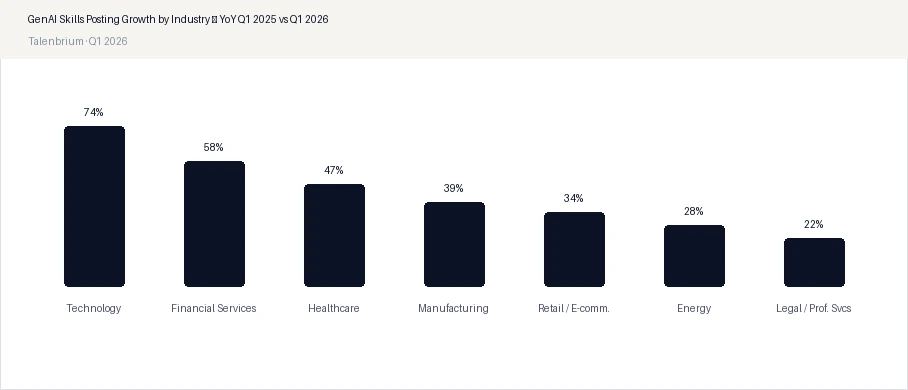

"By May 2026, postings with AI skills had more than doubled versus a year prior, and this growth extends well beyond tech into healthcare, finance, and manufacturing." — Gloat AI Workforce Trends, May 2026
GenAI Skills Posting Growth by Industry — YoY Q1 2025 vs Q1 2026
The full report delivers: a complete skills adjacency map for all 10 GenAI capability clusters — identifying which existing workforce profiles are closest to each target skill and the feasibility of reskilling vs. hiring; compensation premium analysis for each skill cluster at P50 and P90 levels; European vs. US scarcity comparison across 8 markets; employer-level analysis of which organisations are winning the GenAI hiring race and how; build vs. buy vs. reskill cost modelling; and a 12-month forward scarcity outlook based on pipeline and posting trajectory data.
Full data available to purchasers
Table of Contents
01Executive Summary and Scarcity Landscape OverviewPreview
02Market Context: AI Adoption and Skills Velocity 2025–2026Preview
03Skills Taxonomy: 10 GenAI Capability Clusters DefinedPreview
04Scarcity Analysis: Indices, Supply Depth, Time-to-FillGated
05Geographic Variation: US Metro vs. European Market ComparisonGated
06Cross-Industry Spread: Where GenAI Skills Are Being DemandedGated
07Compensation Premium Analysis: What Each Skill Is WorthGated
08Skills Adjacency Map: Reskilling Pathways to GenAI RolesGated
09Employer Analysis: Who Is Winning the GenAI Hiring RaceGated
10Build vs. Buy vs. Reskill: Cost Modelling by Skill ClusterGated
1112-Month Forward Outlook: Scarcity TrajectoryGated
12Strategic RecommendationsPreview
13MethodologyPreview
Report scope
Skills in scope
10 GenAI capability clusters from agentic AI to AI infrastructure
Geography
United States (14 metros) + UK, Germany, France, Netherlands
Industries
Cross-sector · tech, BFSI, healthcare, manufacturing, energy
Data period
Q1 2026 · trend data Q1 2024 – Q1 2026
Primary data
Talenbrium 2.4M+ weekly postings · skills taxonomy engine
Employer tracking
3,200+ technology employers + cross-industry extension
Survey validation
Workforce Pulse Survey Q1 2026 · n=284
External benchmarks
Stanford HAI 2026, ManpowerGroup 2026, WEF FoJ 2025 (validation)
Talenbrium What We Do Strategic Workforce Planning Talent Supply & Demand Analytics Skills Architecture & Intelligence Compensation Benchmarking Location Strategy Diversity & Inclusion Intelligence Industries Technology & Digital Banking & Financial Services Healthcare & Life Sciences Energy, Oil & Gas Manufacturing & Engineering Construction & Infrastructure By Function CHRO & HR Leadership Talent Acquisition Compensation & Benefits Learning & Developmen...
Full data available to purchasers
Assigned Author
Talenbrium Research

Talenbrium Research

Workforce Intelligence Analyst

1

Workforce Intelligence Talent Strategy Labour Market Analysis Research
View Full Author Profile Linked to Talenbrium's public author library
Starting fromUSD 1,999
Single licence · Within 24 hours
What you can customiseGeography, job families, skill clusters, peer groups, data cuts, and delivery outputs can all be tailored to your brief.
Organisation, multi-licence, and bespoke scope pricing available.
10 hours free customisation included.
CategorySkills Intelligence
AudienceAvailable on request
GeographyUS + Europe
Period1
FormatPDF + data tables
Pages86 pages
DeliveryWithin 24 hours

Ready to shape this report around your brief?

Customise the study to your target geography, role, skill cluster, or benchmark set, or request a sample before you proceed.

Customise This StudyRequest Free Sample
Home Reports Insights Contact