
According to Gallup's State of the American Workplace Report 2017, engaged employees are 17% more productive and have 41% lower absenteeism rates than their less engaged colleagues.
Talent mobility is a strategy used in talent management and development. More specifically, this process involves moving existing employees to new positions or departments within the organization. Talent mobility means maximizing the potential of the existing workforce in the company. It is about the ability of people to advance or advance within an organization, regardless of their background. Employees have the opportunity to develop and acquire new skills and grow professionally. This shows employees that the company is investing in their career development. They feel more secure in their careers within the organization. These factors help increase talent mobility within the organization, which is also called internal talent mobility.
Most companies across the globe have serious problems with employee engagement. According to Gallup, only 36% of employees in the United States are committed to their work. Increasing employee engagement can bring many positive benefits to the company. For example, according to Gallup's State of the American Workplace Report 2017, engaged employees are 17% more productive and have 41% lower absenteeism rates than their less engaged colleagues. Gallup also found that engaged employees are much less likely to look for work than disengaged workers, which is 37% compared to 73%.
Challenges in Internal Talent Mobility
While internal recruiting is often a priority for an organization, implementing internal mobility programs can be difficult for various reasons. There is simply a lack of coordinated action. As always, knowing something and taking action are two different things. A lack of incentives can derail even the most elegant talent mobility program. Incentives and control may be the only way to overcome the human inertia that blocks internal recruitment.
It can be difficult to find the skills and experience required for a particular position within an organization. This makes internal recruiting impossible, which is why companies resort to external recruiting. Without clear communication about available positions, job requirements, and career opportunities, employees are unaware of potential internal career paths and therefore seek external opportunities.
Hierarchical structures leave established paths within the internal pyramid but few paths through the organization. Internal mobility often lacks a flexible approach as HR managers focus on existing skills, thereby hindering internal employees' ability to learn as they adapt to a new role. Economic uncertainty means smaller budgets, fewer resources, and more pressure, which means a huge mountain for HR and talent leaders to climb. Although you can do more with less, you need to work smarter, not harder.
Ways To Improve Internal Talent Mobility
Smooth internal mobility requires planning and strategy. Identify mobility paths so the company can communicate opportunities and pursue changes in organizational structures that block internal mobility. Your internal mobility program should continually communicate and encourage ongoing discussions about internal mobility. Large organizations have a complex network of opportunities. HR managers will understandably struggle to balance recruiting needs with available internal talent. Talent management software helps the organization to make sense of it all by increasing the visibility of opportunities and making it easier to identify and develop internal talent. Look for software that enables career paths and internal mobility. This will help you systematize your efforts and make internal mobility accessible and actionable across the organization.
While investing in training and mentoring current employees is not free, it will cost less in the long run than hiring external employees. Training can help employees improve their skills so they can more easily transition into a new internal role and contribute more quickly after the change. A development program also encourages existing employees to stay and makes the company more attractive to external employees. One major initiative is to set an internal recruiting goal. Yes, the goals are arbitrary and not necessarily for recruiting purposes. However, focusing on internal recruiting forces hiring managers to at least consider the wealth of their internal talent. Forcing HR to hire internal employees, at least some of the time, limits the easy default option of hiring external employees.
Talent Marketplace
Talent marketplace is an intelligent, two-way HR and people-driven management platform that can help HR departments better match talent with business needs. Specifically, employees can find and apply for short-term projects, training mentors, or even full-time positions that match their interests within the organization. They can share their skills and vision on the platform, and when opportunities that match their interests arise, the platform intelligently recommends them. At the same time, the platform simultaneously recommends suitable HR candidates using technology. Artificial intelligence enables companies to showcase their talent 'on demand'.
A good talent marketplace can meet a company's current or future talent needs through artificial intelligence and other technologies. It can seamlessly manage the transition of internal employees from their current role to another through internal exploration, invitation intent, and domain-level onboarding, just like a LinkedIn exclusive within the company.
The talent market is a central element of talent management. It enables HR to manage, operationalize, and measure every stage of the talent lifecycle in one place. Additionally, it significantly democratizes the application process and provides a more transparent process for efficiently placing the right people in the right positions. Employees can proactively explore and select potential opportunities within the organization. It enables companies to put their employees' skills at the heart of the process, resulting in huge improvements in business performance.
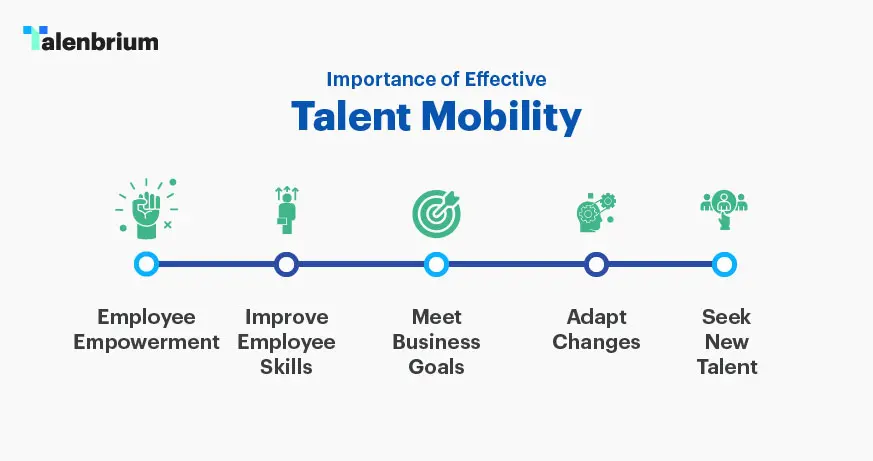
Importance of Effective Talent Mobility
- Employee Empowerment: The talent marketplace allows employees to control their development path by providing recommendations based on their specific goals and personal preferences. Evidence shows that a good employee is often someone willing to drive innovation and learn from other leaders.
- Improve Employee Skills: An internal mobility strategy focused on the talent market can help your employees perform better. New content and work projects, experiences with diverse teams, and a culture of mobility and development give your employees access to more learning opportunities and help your company build a broader knowledge base.
- Meet Business Goals: AI-powered talent marketplace aligns employee skills with business priorities in real-time. A talent marketplace can help HR departments fill key positions quickly by leveraging the hidden skills of talent within the company. As the modern workplace continues to evolve, 'business agility' is a top priority for HR organizations.
- Adapt Changes: Beyond the talent market, the company must be ready to adopt a more efficient way of working, a different type of internal recruiting process, improved learning and development methods and tools, and a comprehensive talent management model and technology platform.
- Seek New Talent: Another major useful feature of talent mobility is displaying the information that the company has about its employees. For managers and HR teams, talent mobility provides a fair and objective way to evaluate talent based on your company's management metrics and more accurately identify skills the company needs, benefiting both the company and employees.
Talent Mobility Adapting Current Changes in Talent Marketplace (350)
Talent mobility allows companies to adapt to technological advancements and changing requirements in the talent marketplace. These can be adapted by implementing various methodologies to cope with emerging trends. Some of the trends in the talent marketplace adapted by organizations by implementing talent mobility are:
- Diversity, Equity, and Inclusion (DEI): By focusing on the characteristics and backgrounds that make people unique, such as race, age, religion, disability, and ethnicity, the company can provide a more holistic view and approach to everything from customer service to marketing and problem-solving. This diversity becomes an advantage that you can use to support your business goals.
- Talent Analytics/Workforce Analytics: From applicant tracking to onboarding, retention, and data-driven decision-making, HR initiatives are increasingly driven by analytics. Even small businesses can use Human Capital Management (HCM) software to record, collect, and report the data they need to improve productivity. The powerful cloud-based HCM software is accessible from anywhere and can be integrated with other key business platforms such as accounting software. HCM solutions also include features that help a team focus on strategic initiatives.
- Employee health and well-being: Typical workplace health and wellness benefits include on-site gyms and member benefits, increased mental health coverage, and financial penalties in the form of insurance premiums for unhealthy habits such as smoking. Remote work and flexible working hours also appear to have mental health benefits, but post-pandemic they are often becoming the norm in many companies. Consider employer-sponsored mental health days, treatment coverage, and family support programs.
- Education, training, and retraining of workers: Training and reskilling benefit both your employees and the company. A LinkedIn survey found that companies with better training have a 53% lower turnover rate, reducing hiring costs and improving productivity. Employees need to learn new skills and companies need to stay up to date with the latest technologies, which is why training and reskilling are so important.
Organizations can ensure effective talent management by appropriately implementing talent mobility along with considering benefits its benefits for employees as well as organizational growth.